End-of-Year Donations and Tax Benefits
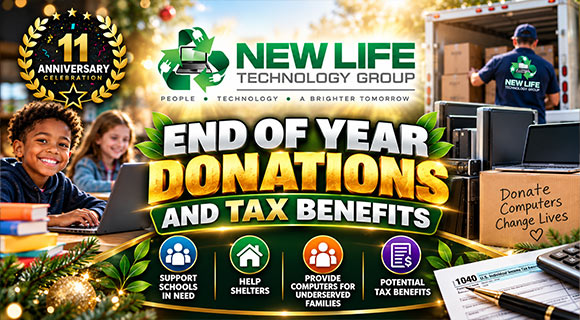
As December approaches, many households and businesses face the same dilemma: what should they do with outdated computers, unused electronics, and equipment taking up valuable space? Throwing these items away wastes potentially useful resources, while storing them indefinitely creates clutter and potential data security concerns. An end-of-year technology donation can turn unwanted equipment into a valuable resource for people who need it, support environmental responsibility, and potentially provide tax benefits when you follow applicable IRS rules.
New Life Technology Group gathered information on end-of-year donations and tax benefits to help individuals, families, and businesses make informed charitable giving decisions before tax season. As a 501(c)(3) nonprofit organization, New Life Technology Group accepts eligible technology donations, refurbishes usable computers and electronics, and distributes equipment to schools in need, shelters, and underserved families through its Computers for Kids Program. Donating before year-end can support digital access, reduce electronic waste, and help eligible donors prepare for tax filing with organized records.
Key Takeaways for End-of-Year Donations and Tax Benefits

Donate before the calendar year ends. For most individuals who use a calendar tax year, a donation generally must be completed by December 31st to count for that tax year. Don't wait until December 31st to arrange a pickup or delivery, especially when equipment requires collection or preparation.
Support families who need technology. Working laptops, desktop computers, and other suitable devices can help students complete assignments, families access online resources, and people seeking employment prepare applications. New Life Technology Group's Computers for Kids Program directs usable technology toward underserved communities.
Reduce electronic waste. Donating functional devices for reuse extends their useful life and keeps electronic equipment out of landfills. Devices that cannot be refurbished may require responsible recycling rather than disposal with ordinary household trash.
Protect private information. Computers and storage devices may contain financial records, personal documents, customer information, or business data. Back up important files and arrange secure data wiping before donating equipment. For devices containing highly sensitive information, ask about appropriate sanitization or physical destruction procedures.
Understand which tax rules apply. Charitable donations don't automatically reduce a tax bill dollar for dollar. A deduction generally reduces taxable income, and the actual benefit depends on eligibility, filing status, income, deduction limits, and other tax circumstances.
Keep the right documentation. Obtain a donation acknowledgment or receipt and record the date, recipient organization, and donated items. For non-cash donations, maintain a reasonable description and valuation based on fair market value and the equipment's actual condition. Additional IRS forms or appraisal requirements may apply to higher-value donations.
Know the rules for 2026. Beginning with tax year 2026, eligible taxpayers who do not itemize may claim a federal deduction for qualifying cash contributions up to $1,000, or $2,000 for married couples filing jointly, subject to applicable rules. This provision applies to qualifying cash gifts, not donations of computers or other physical equipment. Itemized charitable deductions also face a new 0.5% adjusted gross income floor for 2026. Review current IRS guidance before filing.
Make business donations a part of year-end planning. Companies replacing office computers or upgrading technology can consider donating suitable equipment rather than leaving it unused. Business tax treatment can differ from individual tax treatment, particularly for depreciated equipment, inventory, and property previously used to produce income.
Planning ahead of time makes charitable giving more effective. By choosing an eligible nonprofit, preparing devices responsibly, completing donations on time, and keeping accurate records, donors can support community needs while determining whether a tax deduction is available under current law.
We want to thank United Way Forsyth and Dawson Counties for supporting New Life Technology Group’s mission through grants that strengthen its community programs and outreach. This support helps us collect, refurbish, and redistribute technology to people in need. These grants help expand access to computers, reduce electronic waste, and connect underserved individuals and families with valuable technology resources.
You can support our mission with a cash donation by following this link.
Why Donate Outdated or Unwanted Technology?
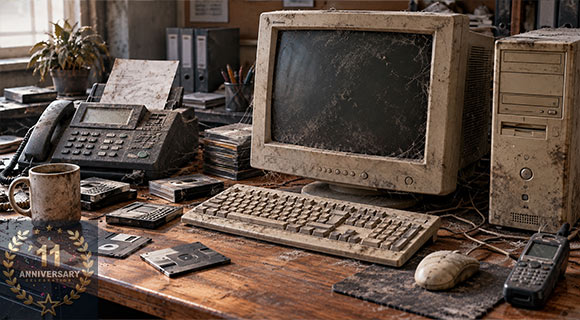
Technology changes quickly. A computer that no longer meets a company's performance requirements may be useful to a student, family, or nonprofit organization. Replacing equipment doesn't always mean the old device has no useful life remaining.
Donating functional technology helps bridge the digital divide. Students need reliable computer access for research, online assignments, educational platforms, and communication with teachers. Families may need devices to apply for jobs, manage household finances, access public services, and participate in online learning. Shelters and community organizations can also benefit from computers that support administrative work, training, and client services.
New Life Technology Group helps connect these needs with donated equipment through its Computers for Kids Program. The organization receives computers and electronics, evaluates their condition, and refurbishes suitable devices for distribution. Equipment that cannot be repaired or reused can be directed toward responsible recycling when appropriate.
Technology donation also supports environmental stewardship. Electronic devices contain materials that require careful handling at the end of their useful life. Reusing working equipment reduces demand for replacement products and delays disposal. Responsible recycling helps recover materials and manage components that should not enter ordinary waste streams.
Businesses can benefit operationally as well. A planned donation process helps staff clear storage rooms, organize equipment replacement projects, and establish a consistent procedure for retiring technology. Organizations can also coordinate data sanitization and asset documentation before equipment leaves their control.
Before donating, confirm which device types the nonprofit accepts and whether they can collect or accept drop-offs. Laptops, desktop computers, tablets, monitors, and accessories may be useful, but acceptance depends on condition, repairability, and current program needs.
Tax Laws and How Donations May Reduce Tax Liability

Charitable giving can provide tax benefits, but the rules depend on what you donate, who receives it, and how you file your return. New Life Technology Group operates as a 501(c)(3) nonprofit, but donors should confirm the organization's current eligibility in the IRS Tax Exempt Organization Search tool and retain documentation for their own records.
Cash Donations and Federal Deductions
For tax years before 2026, individuals generally need to itemize deductions on Schedule A to claim a federal charitable deduction. Beginning in 2026, eligible taxpayers who take the standard deduction may also claim a deduction for qualifying cash contributions to eligible charities, up to $1,000 for most individual filers or $2,000 for married couples filing jointly. Specific eligibility rules and limitations apply.
For taxpayers who itemize in 2026, charitable deductions are also subject to a new floor equal to 0.5% of adjusted gross income. This means contributions below that threshold generally do not qualify for an itemized charitable deduction. Other rules and limitations may affect the final calculation. Tax law can change, so review the current IRS instructions for the year in which you donate.
Donating Computers and Other Physical Equipment
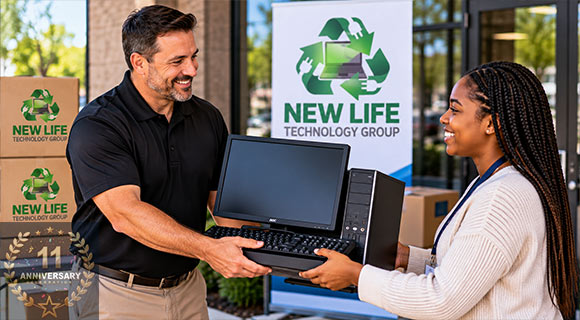
Donations of computers, monitors, and other equipment are non-cash contributions. Unlike qualifying cash gifts under the 2026 non-itemizer provision, non-cash donations generally require the donor to itemize deductions to claim a federal charitable deduction.
For eligible personal property, the deduction is generally based on fair market value - the price a willing buyer would pay a willing seller in an ordinary transaction. The original purchase price is not automatically deductible. A used laptop that cost $1,200 when new may be valued lower (due to age, condition, specifications, and demand).
Special rules can apply to business equipment, including property subject to depreciation. The deduction may depend on the property's adjusted basis, fair market value, holding period, and other tax provisions. Businesses should consult a tax professional before assigning a value or claiming a deduction for retired equipment.
Watch this video to see how New Life Technology Group collects, refurbishes, and distributes computer and electronics donations.
Call New Life Technology Group at 404-313-8215. Visit newlifetechgroup.com to learn more about electronics recycling and the Computers for Kids Program.
Donation Receipts, Valuation, and Required Forms
Keep a written acknowledgment showing the nonprofit's name, donation date, and a description of the donated property. Maintain a separate list identifying equipment models, quantities, condition, and the method used to estimate fair market value. A nonprofit receipt does not automatically establish a particular dollar value for tax purposes.
IRS substantiation requirements vary by donation value. Non-cash gifts generally require additional documentation as claimed value increases. Form 8283 may be required for non-cash contributions, and a qualified appraisal may be necessary for certain property deductions above $5,000, subject to exceptions. Review IRS Publication 526 and the instructions for Form 8283 before filing.
Do not inflate equipment values or assume every donated item qualifies for a deduction. If you receive goods or services in exchange for a contribution, the deductible amount may be reduced. Keep all records with your tax documents and seek professional advice when donating valuable business equipment or navigating a complex tax situation.
How to Prepare Technology for Donation

Start by identifying equipment that your household or business no longer needs. Separate functional devices from those requiring repair, and contact New Life Technology Group to confirm current acceptance guidelines. Include available power adapters and essential accessories when possible.
Next, protect personal and business information. Back up needed files, sign out from accounts, remove removable media, and arrange secure data sanitization. Simply deleting files or performing a quick reset may not meet security requirements for every device. Businesses should follow their internal data retention, privacy, and asset disposal policies.
Then prepare an inventory. Record the equipment type, manufacturer, model, serial number when appropriate, and general condition. For business donations, retain asset records and coordinate approval with the department responsible for equipment disposal. Ask the nonprofit for a written acknowledgment and keep records showing when the organization received the items.
Finally, schedule the donation early. Nonprofits may experience higher demand for pickups and drop-offs near year-end. Completing the process in advance gives the recipient time to assess equipment and helps donors avoid uncertainty about whether a contribution was completed during the intended tax year.
Make Your Year-End Donation Count
New Life Technology Group provides an opportunity to turn unwanted technology into practical support for schools, shelters, and underserved families. Through its Computers for Kids Program, the organization receives and refurbishes suitable equipment for donation, helping more people access the computers they need for education, communication, and daily life. Donors can also support responsible electronic reuse and recycling while learning whether their contributions qualify for tax benefits.
Planning eligible donations before year-end can free up space, extend technology's useful life, and contribute to meaningful community programs. Accurate records, appropriate data sanitization, and an understanding of current IRS requirements help make the process smoother. To learn about equipment donations or support the Computers for Kids Program, visit https://newlifetechgroup.com/donate.
Delaying donation decisions can leave usable computers sitting unused, increase storage burdens, and postpone access for families and organizations that need technology. Improper disposal can also create unnecessary electronic waste; missing records or misunderstanding tax rules can prevent donors from claiming a deduction they might otherwise qualify for. By planning ahead, donating responsibly, and keeping reliable documentation, individuals and businesses can make their year-end contributions more useful to their communities and easier to manage at tax time.
Dawsonville, GA 30534
(404) 313-8215